Showing posts with label legume. Show all posts

Saturday, November 22, 2014

Italian Baked Beans (gluten free)


Pioneer Baked Beans was one of the most popular posts at my blog with time more then 6,000 hits.  Who'd a thought? Retro and comfort foods are supposed to continue to be big this year and as the weather gets colder here I for sure have been turning to home cooked soups, stews and casseroles.

Often I don't want the meat and the fat from the pork so I make a vegetarian version of baked beans. I have made these beans in the oven in a casserole baking dish, cast iron Dutch oven and also in a slow cooker. My instructions show slow cooker method followed by stove top and oven. The version below has cheese but it is easy to make VEGAN by skipping the cheese or topping with my recipe for quinoa polenta and toasted sunflower seeds.

Click this link for a printable recipe.

INGREDIENTS:
1 cup White pea or “Navy” beans - any dry bean - 250 ml
½ tsp Fennel seed - 2.5 ml
½ tsp Thyme - 2.5 ml
1 tsp Basil - 5 ml
1 Tbsp Hot chile pepper - 15 ml
1 cup Onion, diced - 250 ml
2 Garlic, cloves, minced 
24  Carrots, baby, medium 
28 fl oz Diced tomatoes, canned, with juice - 798 ml
5 fl oz Tomato paste, canned - 156 ml
1 cup Wine, white, dry - 250 ml
1 ¼ lb Polenta, tube, ready to serve (e.g., Aurora brand) - ½ kg
¼ cup Romano cheese, shredded - 60 ml
1 cup Mozzarella cheese, part skim, shredded  - 250 ml
¼ cup Parsley, fresh, minced - 60 ml
½ tsp Paprika, sweet, ground - 2.5 ml

SLOW COOKER METHOD:
1. Soak beans in plenty of cold water over-night - use three times their volume of water. You can do this in the crock of the slow cooker. Drain.
2. Add fennel, thyme, basil, a whole chili (optional), chopped onion and minced garlic to the beans. Add 2 liters (8 cups) cold water to cover. This amount of water is an estimate. You can add more later if it is needed.
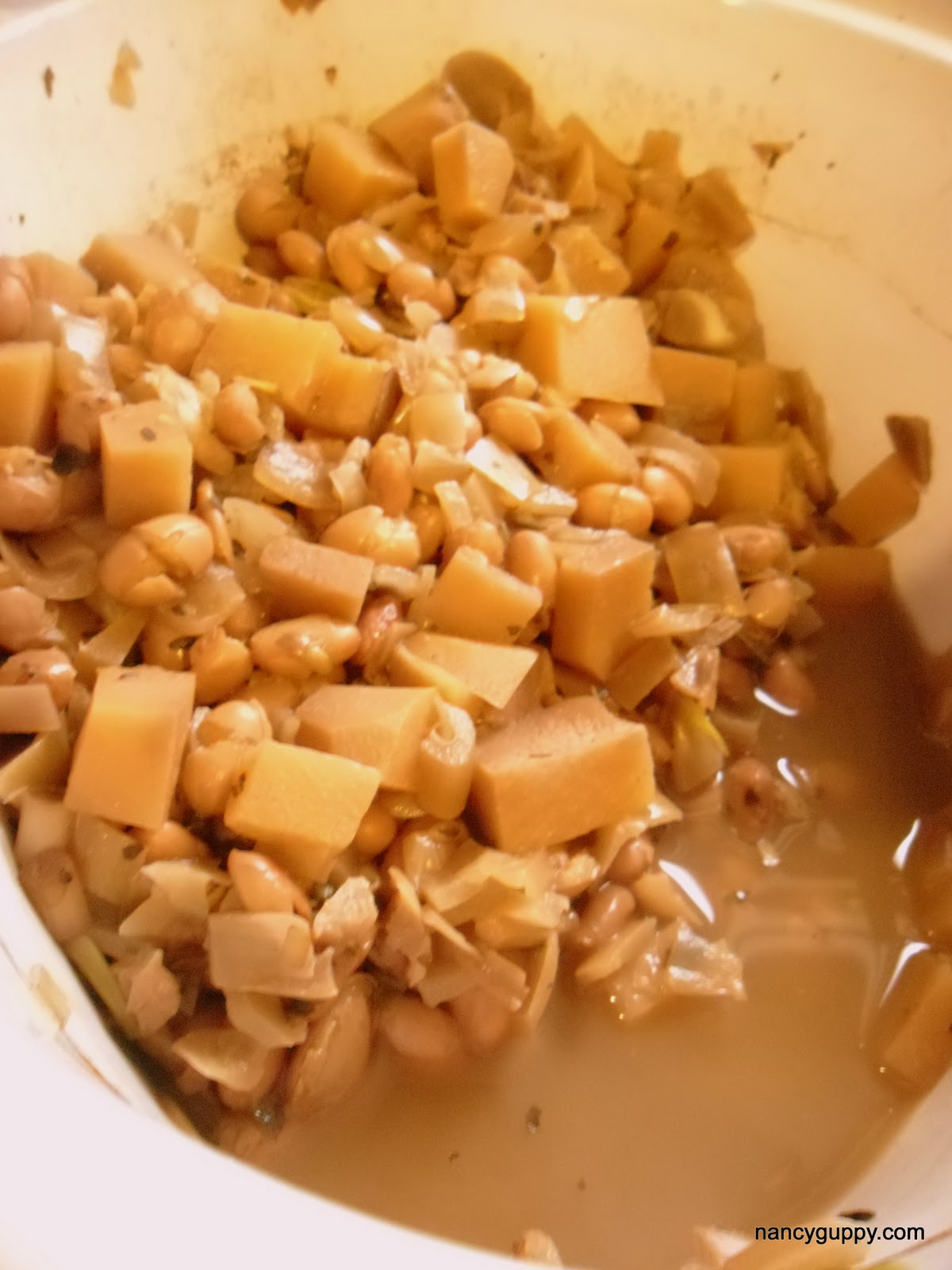
3. Stir in whole baby carrots. I used some cubed rutabaga the second time I made this as I was out of carrots. Necessity is the mother of invention. Cover and cook on LOW 4 hours. The beans should be tender and most of the liquid absorbed. It looks a little monotone with the turnip but this gets corrected.


4. Stir in slivers of coloured peppers, canned diced tomatoes with liquid, tomato paste and white wine. Cover and cook an additional. 2 hours. Taste it and see if it needs salt, more herbs etc. The polenta and cheese topping will add some saltiness so go easy.


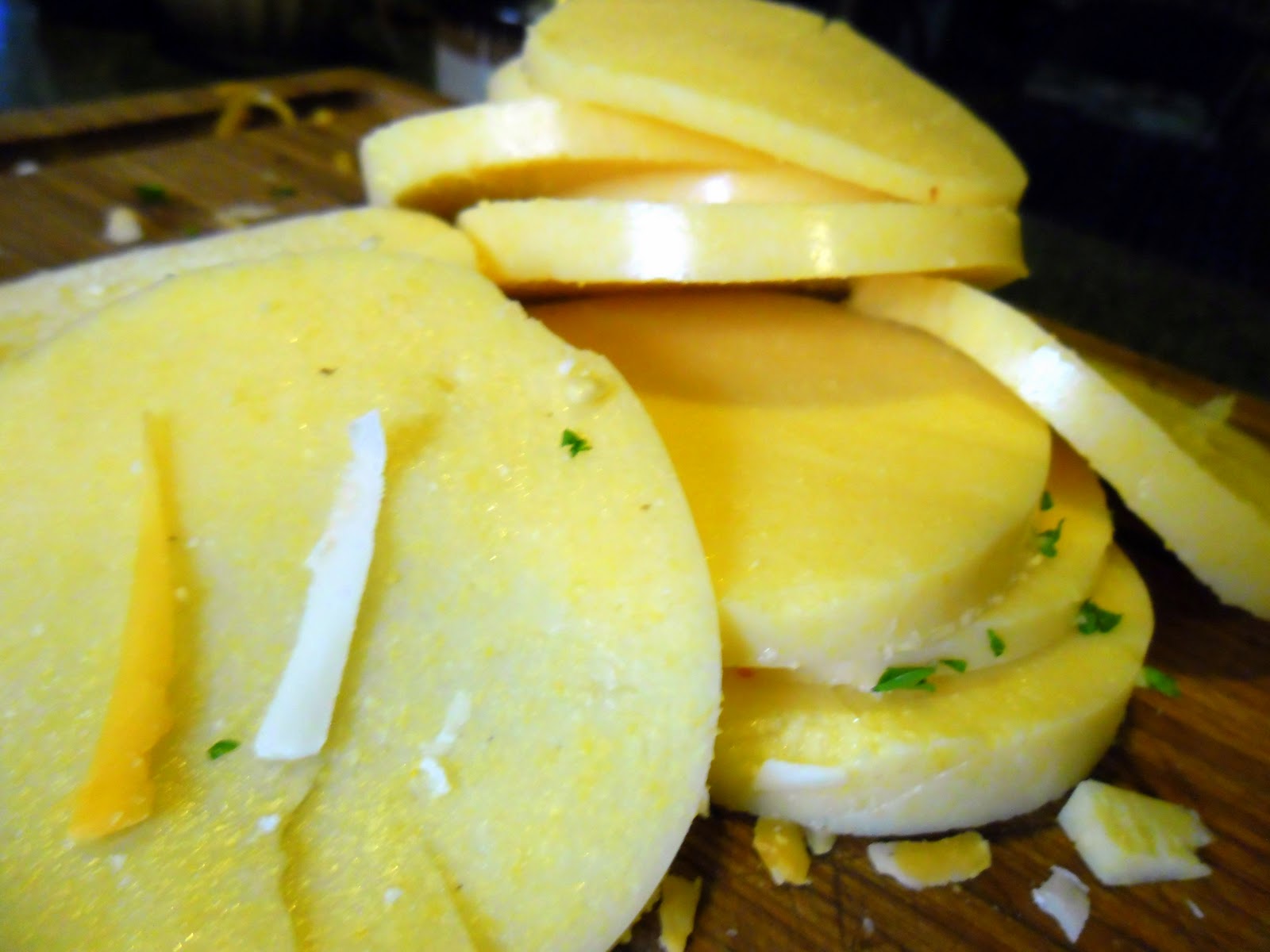
5. Slice polenta into rounds.


Arrange polenta rounds on top of the beans. Push them down into the beans a bit.


Then sprinkle on the grated Romano and mozzarella cheeses (optional). I sprinkled on some fresh parsley and paprika last for colour.


Cover and heat on low until bubbling and cheese is melted. I don't have a picture of the final product as my son and I were pretty hungry and had devoured a lot of it by the time I remembered I hadn't taken a picture.

STOVE TOP version:
1. Add dry beans to stockpot and cover with 3 times their volume of water. Bring to a boil for 2 minutes. Remove from heat, cover and let sit 1 hour.
2. Drain discarding liquid. Return soaked beans to pot along with 3 times their volume fresh water. Add fennel, thyme, basil, hot pepper, diced onion and minced garlic. Bring to a boil; reduce heat and simmer 30-45 minutes or until tender. Drain, reserving 2 cups cooking liquid.
3. In oven proof casserole combine cooked beans, reserved liquid, baby (or chopped) carrots, slivers of yellow pepper, can of tomatoes with juice, tomato paste and white wine. Cover and bake at 350'F for 2 hours.
4. Top with sliced polenta rounds. Push them down into the beans a bit. Then sprinkle on the grated Romano and mozzarella cheeses (optional). I also sprinkled on some fresh parsley and paprika last for colour. Cover and bake another hour or so until bubbling and cheese is melted.

Nutrients (per 1/8th of recipe – about 350 g): 280 calories, 14 g protein, 5 g fat, 2.5 g saturated fat, 37 g carbohydrate, 10 g fibre, 10 mg cholesterol, 640 mg sodium.  %DV (Daily Value) are 25% calcium and iron, 120% vitamin A and 130% Vitamin C. Darned good nutritionally and marvelous winter food!

Yours in good taste, © Nancy Guppy, RD, MHSc.  http://nancyguppy.com/


Friday, December 2, 2011

Greek Lentil Salad Vinaigrette (gluten free)


Here is a simple take on Greek salad.  It comes together quickly and can be the hit at your next family or office pot-luck.  The lentils pack a lot of vegetable protein, complex carbohydrate, fibre, potassium, B vitamins and iron.  Substitute any cooked bean of your choice such as chickpeas or a can of mixed beans for the lentils.  I have even made it with cooked wild rice and everyone loved it.  


The original recipe is from Pulse Canada.  Visit their website for lots of good ideas and recipes for cooking and baking with legumes or pulses (=beans, peas and lentils).  Legumes have lots of health benefits.  They point out that  "studies have shown that consuming pulses can benefit people with diabetes. As a good source of complex carbohydrates, pulses have a low glycemic index which means they keep blood sugars from rising too quickly after eating."  They are gluten free too and a great source of iron for people that run low on this vital nutrient.  If you want to learn more about legume nutrition and how-to-cook them visit my earlier post Lesson in Legumes.


Nutrition TipRunning canned beans/lentils under cold water to rinse and then leaving to drain for a few minutes can reduce the sodium content of canned legumes by as much as 40%. That's pretty good!


INGREDIENTS:


Imperial
Metric Measure
Ingredients
2 cup
500 ml
Lentils, brown, cooked, drained
½ cup
125 ml
Onion, diced
2 cup
500 ml
Tomatoes, fresh, diced
1each
1
Green or red pepper, diced
½
½
Cucumber,  English cut in quarters lengthwise and then sliced (21 cm)
¼ cup
60 ml
Parsley, fresh, minced
2 Tbsp
30 ml
Olive oil, extra virgin
3 Tbsp
45 ml
Lemon juice, fresh squeezed
1 cup
250 ml
Feta, crumbled (about 175 grams)
1 Tbsp
15 ml
Oregano, leaf, dry
½ tsp
2.5 ml
Black pepper, freshly ground


METHOD:


1.  Rinse the canned lentils under cold running water and leave to drain. Alternately, use 2 cups (500 ml) of cooked-from-scratch lentils.  Add to a large bowl.  


2.  Toss in the diced onion, tomatoes, green/red pepper, sliced cucumber and minced fresh parsley.


Here my tomatoes look a little sad.  It is December 2nd and they are the last two I have left from my summer garden.


3.  Pour olive oil and fresh squeezed lemon juice over salad.  Top with crumbled feta and sprinkle with dried oregano and freshly ground black pepper.  I used a crumbled goat's milk feta and both my son and I really liked it.


Toss and adjust seasonings to taste.  You can also use dried thyme or mixed Italian seasoning instead of the oregano.


NUTRITION FACTS (per 1/12th recipe about 1/2 cup - 125 ml - 110 g): 110 calories, 6 g fat, 2.5 g saturated fat, 15 mg cholesterol, 170 mg sodium, 11 g carbohydrate, 2 g fibre, 3 g sugar and 6 g protein.  %Daily Values are 8% vitamin A, 45% vitamin C, 10% calcium and 10% iron.


Tastefully yours,
Nancy Guppy, RD


Visit me at www.chapmanslanding.com where you can find out what's cooking on my class calendar.  If you are interested in nutrition or diet counselling pop over to www.nancyguppy.com.  A lot of health plans cover the cost of consulting an RD.


Tuesday, March 1, 2011

Pioneer Baked Beans with Pork Hocks

I got into making old fashioned baked beans this past winter.  Dried white "pea" or "Navy" beans, molasses and pork were staple foods of many Canadian pioneers. I fooled around with a few versions trying to make something close to the ones my father used to make.  He preferred the dry baked beans and used both molasses and brown sugar.  Some people, including my mom, like to make a saucier baked bean.  If you want them saucier you just add more water during baking.  

Although this recipe uses pork hocks it isn't hard to make a vegetarian version and I have done it often.  You just omit the meat and you can also add some chopped carrots, parsnips, potatoes or squash etc.


Click on this link for a printable version of the recipe.

INGREDIENTS:
2 cups (500 ml) white beans "Navy" (1 pound - 450 grams)
cold water for soaking
1/2 cup (125 ml) molasses
1/4 cup (60 ml) brown sugar
1/2 cup (125 ml) ketchup
1 Tbsp (15 ml) dried mustard powder (like Keens)
1/2 tsp (2.5 ml) salt
1 onion, large, peeled, cut in half
4 whole cloves (spice)
2 lb (900 g) pork hocks

METHOD:
 
1.  Soak beans overnight in plenty of cold water.  


Quick soak method: cover beans with 3 times their volume of cold water.  Bring to a boil and boil for 2 minutes.  Remove from heat, cover and let stand for 1 hour.

To cook add more cold water to cover by 2 inches and bring to a boil.  Reduce heat and simmer, covered, for 1 hour.  Drain liquid and set aside (do not throw out liquid).  Place beans in a 12 cup (3 litre) bean pot or casserole.  You can also use a roasting pan that has a lid.  You can also make these in the slow cooker.  It will take longer and I don't find they taste quite as good as those baked in the oven.

2.  Add the molasses, brown sugar, ketchup, dry mustard and salt to the bean pot and stir well to combine.


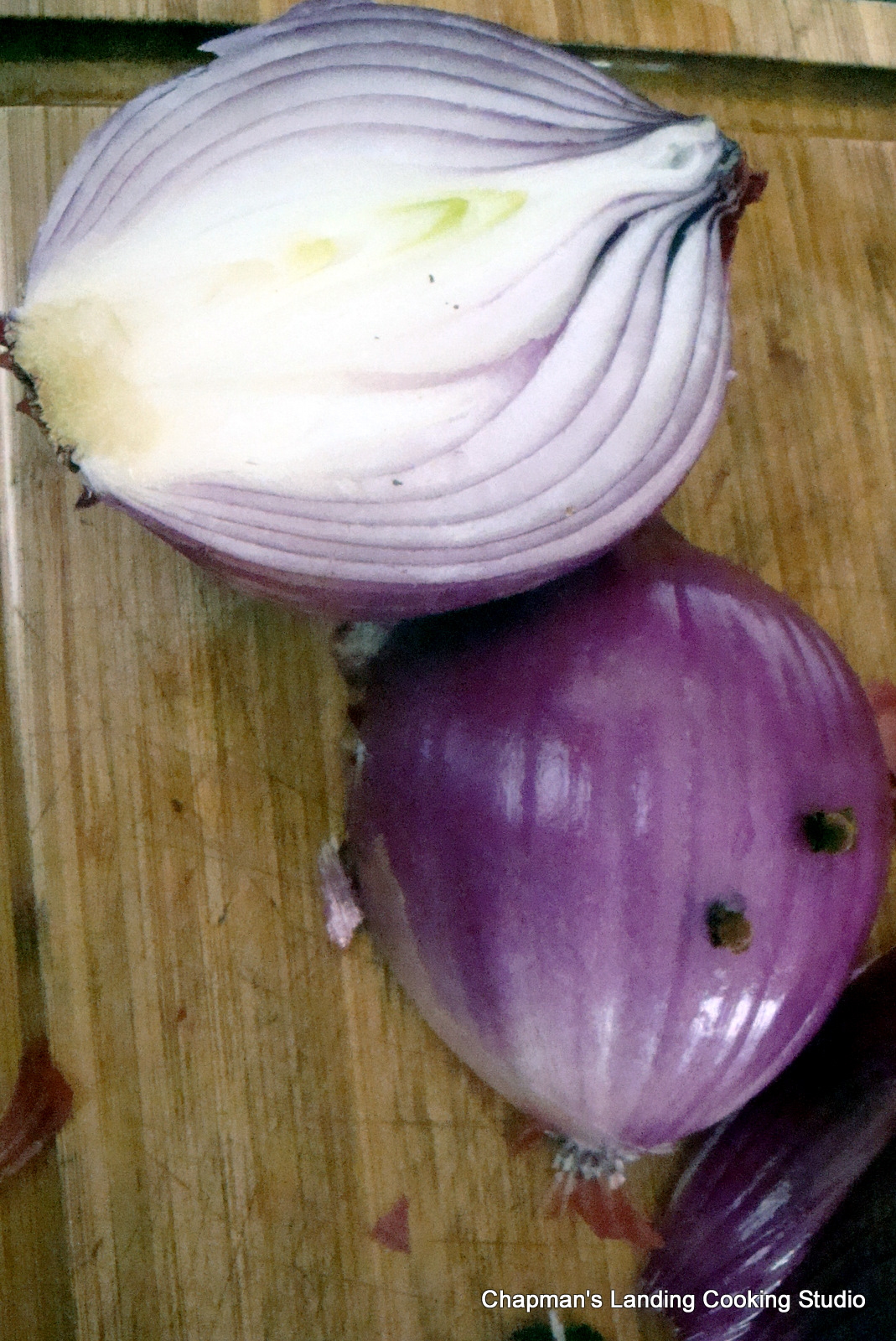
3.  Cut onions in half lengthwise and peel.  Push two whole cloves into each half and bury in the beans.

   
4.  Push pork hocks into the beans as well. 


5.  Add enough reserved liquid to cover the bean mixture.  Cover and bake in a 250’F (120’C) oven for 6-9 hours or until liquid is mostly absorbed and beans are tender.  They need to cook down to be very soft and deeply browned.  If they seem too dry you can stir in some more of the reserved cooking liquid during baking.  The beans will absorb a lot of the moisture.  Some people take the lid off during the last hour of baking to make the beans darker.  I usually skip that step and the photo below is of beans baked with lid on the whole time.


6.  Below I show how I took the pork hocks out of the finished beans and set them on a plate until cooled.  When cool enough to handle remove the meat and stir back into the baked beans.  Discard the fat and bones.  


That's it!  Enjoy your beans.  There is no nutrient analysis on this one LOL.  Pork hocks aren't in the ingredient data base of my software and you don't eat the bone or most of the fat so it seemed pretty impossible to do. Dried beans are high in protein, fibre, folate, iron and a skad of other vitamins and minerals.

Monday, January 10, 2011

Lesson in Legumes


Pulse: from the Latin puls, meaning thick soup or potage, pulses are the edible seeds of plants in the legume family such as pea, lentil, bean and chickpea.
Source: Pulse Canada.
Legumes, or pulses refer to beans, chickpeas, peas and lentils. The term legumes can be confusing in Canada as it means vegetables in French.  Pulses are staple foods in most cultures around the world and for good reason.   They are hearty winter foods and this time of year my slow cooker runs pretty much daily.

Last spring I was able to purchase about 1.5 kg (3 lb) of dried Cranberry, Pinto and Great Northern white beans from a local vendor at the Powassan's Farmer's Market. I am hopeful that sources for local legumes will emerge as more people take to farming local foods.  It takes a lot of plants to produce even a single cup of dried beans. Each seed pod of the Yin Yang beans I grew last summer only produced 4 or 5 dried beans.  My garden isn't that large and we eat our beans when young and before the seeds  have dried.

I was part of the dietitian review group for the "Cooking with Beans, Peas and Lentils" publication from Pulse Canada.   Download a copy at this link or cruise their recipes at the website. It contains many easy nutritious recipe ideas and tips on buying, storing and cooking with pulses. At the site you can also learn more about the health and nutrition of pulses.  Pulse Canada encourages people to eat more legumes as part of an overall strategy for a healthy planet:
"When you’re eating products made from pulses, you’re making an environmentally-friendly food choice. From the legume family, pulses take less energy to grow, producing fewer greenhouse gases. Pulse crops are also one of the most environmentally-friendly sources of protein, and contribute to sustainable food production by protecting and improving soil and water resources."
The bulk of legumes in Canada are grown in the western provinces of Alberta, Manitoba and Saskatchewan.  Canada is in fact the world's top exporter of pulses.  I was surprised to find out we grow more pulses than any other country in the world other than India. The strong demand for gluten free foods has increased use of pulses in Canada and around the world.  Yes export is wonderful but we really should eat more of them!


Beans (phaseolus vulgaris) are indigenous to the Americas and historically have been an important source of protein and nutrients to the native people.  The Three Sisters of corn, beans and squash are traditionally grown together as companion plants.  Half the beans grown in Canada are grown in southern Ontario.  Visit the Ontario Bean Producers for great recipes and information.   Our largest bean crop is the white pea bean ("Navy") that is traditionally used in pioneer pork and beans but you will find a multitude of other uses.


Chickpeas (cicer arietimum) can be "desi" and "kabuli" or a.k.a. garbanzo beans.  Gram flour or besan is made from brown, small chickpeas and is used in Indian style cooking.  I like the pakoras vegetable fritters which use this bean flour.  Below is the Eat Well Gourmet Carrot Chickpea Salad and the recipe is posted at this blog.


Peas (psium sativum) are now being used by food manufacturers as pea flour, pea protein and pea fibre in foods from gluten-free baked goods to "pea butter" or "NoNuts" a peanut butter substitute.


Lentils (lensculinaris) grown in Canada vary between large and small and green, red and brown.  They are a good starting place for the novice legume user as they don't need to be soaked.  Just a quick rinse and you can cook them up in 20 or so minutes.


Legumes are worth exploring further.  You can learn how to make easy and nutritious appetizers, soups, salads, main courses and even desserts with legumes.  My favourite use of legumes includes dahl (curried lentils), split green pea soup, Southwest black bean and brown rice salad, negro frijoles (refried black beans), channa (curried chickpeas), sweet and sour baked "Navy" beans and good old minestrone soup with any kind of bean.

Eat half a cup (125 ml) daily and get the health benefits of thse nutritional super foods.  Here is my short list of the potential benefits of eating legumes regularly as part of your healthy diet:
- economical and environmentally friendly
- high in soluble and insoluble fibres, vegetable protein and a variety of health promoting nutrients
- boil your own from scratch and they are low in sodium
- low glycemic index can help manage your blood glucose
- promote satiety (make you feel full longer) and help manage weight
- lower your LDL or "bad" cholesterol and triglycerides
- lower risk of cancers, particularly prostate cancer
- help prevent constipation.

Legumes are also gluten free and can provide many nutrients required to achieve a healthy vegetarian diet. One food guide serving of beans as an alternative to meat is 175 ml (3/4 cup) - about the size of a tennis ball.  If you have a healthy diet with good variety you can meet your protein needs with 2-3 servings of meat alternatives a day.

On the downside legumes have a reputation for being musical fruit.  The gas producing nature of legumes comes from the oligosaccharides or resistant starch.  These complex sugars are digested in the colon producing short chain fatty acids which act as prebiotics or food for friendly bacteria in the gut.  It is the probiotic bacteria that fend off pathogens and contribute to improved immunity and overall good health.  The high fibre is also partly to blame for the gas.

Some people recommend you soak dried beans before cooking and pour off the liquid and most of the indigestible sugar that causes flatulence.  The problem with this approach is you also pour off water soluble nutrients like the B vitamins.  My suggestion is to slowly increase fibre and legumes into your diet and to make sure you drink enough water on a daily basis.  Expect some gas.  It is natural!

Tastefully yours,
© Nancy Guppy, RD, MHSc
Chapman's Landing Cooking Studio
My next cooking class at Chapman's Landing is "I’m a Slow Cooker” on Saturday February 5th.  Please see my menu and register online.